
Ordinance and law coverage pays the extra cost of rebuilding a damaged building to today’s building codes — including tearing down and hauling away undamaged sections the code no longer allows you to keep, and the higher cost of rebuilding to current standards. A standard commercial property policy pays to put the building back the way it was; it does not, on its own, pay the added cost that local code now forces on the rebuild, and on an older building that gap can run into six figures.
Most owners discover ordinance and law the hard way: after a fire or storm, when the building inspector requires the rebuild to meet current code and the property policy stops at “like kind and quality.” The difference — new sprinklers, updated wiring, ADA access, current structural and energy standards, sometimes demolition of walls that survived the loss — falls on the owner unless ordinance and law coverage is in place and sized correctly. This article explains what the coverage pays, what triggers it, how its three parts work, and where the sublimits quietly leave older buildings short.
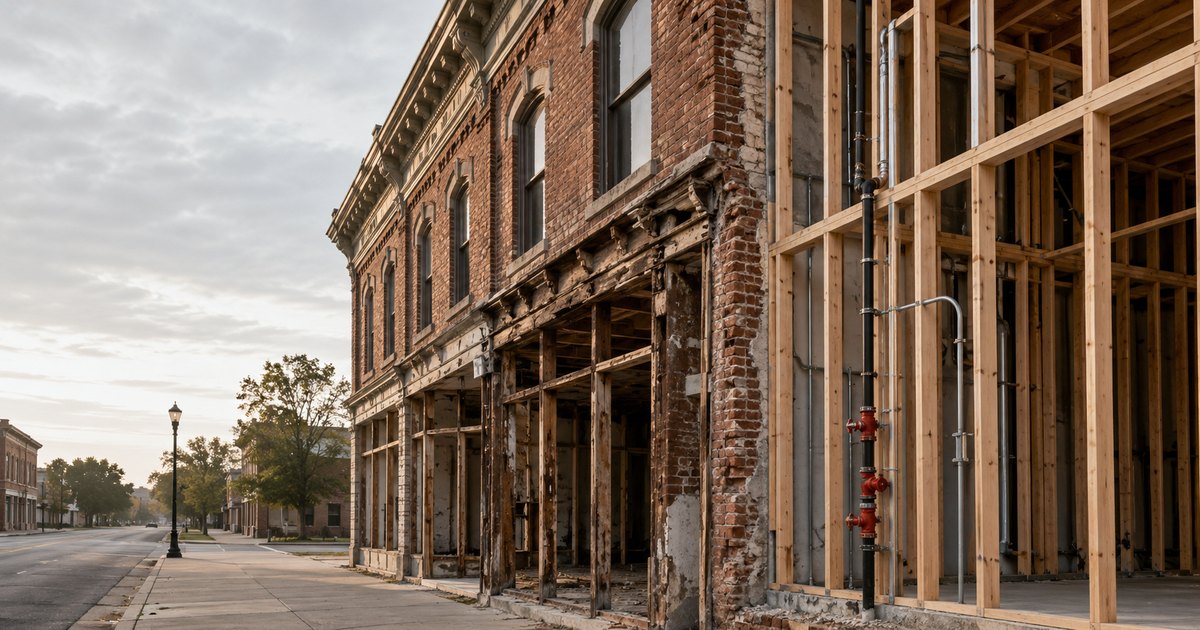
What does ordinance and law coverage actually pay?
When a covered loss damages an older building, two costs appear that a base property policy was never designed to carry: the cost of complying with codes that did not exist when the building went up, and the cost of demolishing or removing portions the loss did not touch but the code will no longer let you keep. Ordinance and law coverage is the endorsement that funds both, and it sits squarely inside a well-built commercial property insurance program rather than being assumed into it.
Ordinance and law coverage pays the increased cost to repair, rebuild, or demolish a damaged building so that the work complies with the current building codes, zoning, or land-use ordinances in force at the time of loss — costs a standard property policy excludes because it only pays to restore the building to its pre-loss condition. The base policy answers the question “what did the building cost to replace as it was?” Ordinance and law answers a different one: “what does the city now require to make it legal again?” On a building constructed under a 1970s or 1980s code, those two numbers can be very far apart — which is the same valuation gap that drives the replacement cost versus actual cash value decision on the building itself, now compounded by code. A complete commercial insurance program treats the two as one connected exposure, not two unrelated line items.
What triggers ordinance and law coverage?
The trigger is not the age of the building by itself — it is a covered loss to an older building in a jurisdiction that enforces current code on the rebuild.
Ordinance and law coverage is triggered when a covered peril damages a building that no longer conforms to current code, and the local authority requires the repair or rebuild to meet today’s standards rather than the standards in place when the building was originally constructed. The more out of date the building, the larger the trigger: a structure built to a decades-old code may need updated fire suppression, electrical service, plumbing, structural bracing, accessibility, and energy-efficiency work before the city will issue a certificate of occupancy.
The detail that turns a modest claim into a major one is the damage-threshold rule. Many jurisdictions enforce a percentage-of-damage rule — commonly around 50% — under which a building damaged beyond that threshold can no longer simply be patched back; the entire structure must be brought up to current code, and in some cases demolished and rebuilt from the ground up. A fire that destroys 60% of an older building can therefore force a 100% code-compliant rebuild, including the portion that survived. Aging building systems make the trigger more likely, too — the same out-of-date wiring and mechanical equipment that drives an equipment breakdown exposure is exactly what a current code will require you to replace once the building is opened up for repair.
Iowa makes this concrete. Many of the commercial buildings lining Iowa’s main streets and older downtown cores — Des Moines, Cedar Rapids, Davenport, and the small-town squares in between — predate modern building codes by decades, and rebuilds are governed by the Iowa State Building Code and the locally adopted editions of the International Building Code. When one of those buildings is substantially damaged, the rebuild is held to the current edition, not the one the building was born under, and the code-upgrade cost lands on the owner.
How do Coverage A, B, and C work?
Ordinance and law coverage is written in three distinct parts, and they do not all carry the same limit — which is where most of the trouble starts.
Coverage A — loss to the undamaged portion of the building — pays for the value of the undamaged part of the structure that must be torn down because the ordinance will not allow it to remain. Coverage A is usually included within the building’s replacement cost limit rather than carrying a separate sublimit, so it is the one part most owners already have if the building is insured to full replacement value.
Coverage B — demolition cost — pays the cost to demolish and clear the site of the undamaged portion of the building that the code requires you to remove. This is the cost of the wrecking crew and the hauling, not the value of what is torn down — and it is a real, separate line item on any code-driven rebuild.
Coverage C — increased cost of construction — pays the additional cost of repairing or rebuilding to comply with current code: the upgraded sprinklers, wiring, accessibility, structural, and energy work the city now requires. Coverage C is typically the largest of the three on an older building and the one most often underfunded. Together, B and C are usually subject to a separate dollar sublimit that has nothing to do with the building’s full replacement value — and that sublimit is where the coverage tends to fall apart.
Where do the sublimit traps hide?
A policy can show “ordinance and law — included” on the declarations page and still leave a six-figure gap, because “included” usually means a small, fixed sublimit on Coverage B and C.
The most common ordinance and law failure is a Coverage B and C sublimit set far below the actual code-upgrade and demolition cost — a token amount such as $25,000 or $50,000 carried forward year after year on a building whose real code-driven rebuild cost is several hundred thousand dollars. The sublimit is easy to miss because the building limit itself can look healthy; the shortfall is buried in the ordinance and law line, and it only surfaces at the claim. The same quiet-until-the-claim dynamic that makes a coinsurance penalty so damaging applies here — the number looks fine on paper and fails at the worst possible moment.
There is a second, slower trap: time. Code-driven rebuilds take longer than like-for-like repairs because of added engineering, permitting, and inspection, which extends the period the business is closed. If the ordinance and law endorsement does not coordinate with an increased period of restoration on the income side, the owner can run out of business income coverage while the code-compliant rebuild is still underway. The physical-damage gap and the income gap compound each other.
How does Avanti Group right-size ordinance and law coverage?
At Avanti Group, ordinance and law is never left at a default sublimit copied forward from the expiring policy. Before recommending limits, the firm runs a Business Risk Diagnostic™ — establishing the building’s age and original code vintage, identifying the upgrades a current-code rebuild would actually require, estimating realistic Coverage B and C costs for that specific structure, and coordinating the ordinance and law limit with the building’s replacement cost valuation and its period of restoration so the physical and income sides do not fail independently.
That sequence — understand the building, quantify the code exposure, then talk about price — is the opposite of how ordinance and law is usually quoted, and it is the difference between a commercial property program that funds a code-compliant rebuild and one that leaves the owner writing a six-figure check to satisfy the building inspector. Most agents accept the factory sublimit and move on; Avanti does not, because ordinance and law is precisely the line where a fast quote hides its shortfall — and where treating the cheapest-looking policy as the cheapest policy quietly inflates the total cost of risk. If you own an older building, it is worth pressure-testing the ordinance and law limits inside your full commercial insurance program before a loss does it for you.
Frequently Asked Questions
What is ordinance and law coverage in commercial property insurance?
Ordinance and law coverage pays the additional cost of rebuilding a damaged building to comply with current building codes, zoning, and land-use ordinances — costs a standard property policy excludes because it only pays to restore the building to its pre-loss condition. It has three parts: Coverage A pays for the value of undamaged portions the code requires you to tear down, Coverage B pays the demolition and debris-removal cost of those portions, and Coverage C pays the increased cost of construction to meet current code. The coverage matters most on older buildings, where the gap between “rebuild as it was” and “rebuild to current code” can be very large.
What triggers ordinance and law coverage?
It is triggered when a covered peril damages a building that no longer conforms to current code, and the local authority requires the repair or rebuild to meet today’s standards instead of the code in place when the building was built. The damage-threshold rule is the key amplifier: many jurisdictions require that a building damaged beyond a set percentage — often around 50% — be brought entirely up to current code, sometimes including demolition of the portion that survived the loss. The older the building, the more upgrades current code will require, and the larger the triggered cost.
What is the difference between Coverage A, B, and C?
Coverage A pays for the value of the undamaged portion of the building that must be demolished because the ordinance will not allow it to remain, and is usually included within the building’s replacement cost limit. Coverage B pays the cost to demolish and clear the site of that undamaged portion — the wrecking and hauling cost. Coverage C pays the increased cost of construction to rebuild to current code, such as upgraded sprinklers, wiring, accessibility, structural bracing, and energy standards. Coverage B and C are typically subject to a separate sublimit, which is where most ordinance and law shortfalls occur.
Why is the ordinance and law sublimit a problem?
Because a policy can show “ordinance and law — included” while carrying only a small fixed sublimit on Coverage B and C — for example $25,000 or $50,000 — that has nothing to do with the building’s real code-upgrade and demolition cost. On an older building, the actual code-driven rebuild cost can run into the hundreds of thousands, so the token sublimit leaves a six-figure gap that does not appear until the claim. The building limit can look perfectly healthy while the ordinance and law line quietly fails. Sizing Coverage B and C to the building’s actual code exposure, rather than accepting the default, is what closes the gap.
Do newer commercial buildings need ordinance and law coverage?
The exposure is largest on older buildings, but newer buildings are not fully exempt. Codes change continually, and even a building constructed within the last decade can face upgrade requirements at the time of a future loss — and zoning or land-use changes can affect what may be rebuilt on the site at all. Because the cost of adding ordinance and law coverage is generally modest relative to the gap it closes, most commercial buildings benefit from carrying it with adequately sized Coverage B and C limits. The right limit depends on the building’s age, construction, and the code environment where it sits, which is part of what a proper property review establishes.