
A fleet safety program is a written, enforced set of rules for how a business hires drivers, maintains vehicles, monitors driving behavior, and responds to crashes — and “proving it” means documenting that the program exists, that it is followed consistently, and that it produces measurable results an underwriter can verify. Carriers convert that proof into premium credit because a documented, working program lowers the odds of the large loss they are pricing for.
Most businesses have pieces of a fleet safety program living in someone’s head — a sense of who the good drivers are, a habit of fixing brakes when they squeal, a general expectation that people drive carefully. Underwriters cannot price a habit. They reward what is written down, applied to every driver and vehicle, and backed by records. This article walks through the five components carriers look for — a written policy, a driver qualification file, telematics, cameras, and a post-accident protocol — and, just as importantly, how to package that proof so it converts into an actual credit on your commercial auto premium.
- Why do underwriters reward a fleet safety program?
- What are the five parts of a fleet safety program underwriters look for?
- Is there a written fleet safety policy?
- Is the driver qualification file complete?
- Does the fleet use telematics?
- Are cameras installed, and what do they capture?
- Is there a written post-accident protocol?
- How does a fleet safety program convert into premium credit?
- How Avanti Group helps prove your fleet safety program
Why do underwriters reward a fleet safety program?
Underwriters reward a fleet safety program because commercial auto is a severity line — the losses that move the premium are the rare, catastrophic ones, and a documented program is the clearest evidence a business is actively reducing the odds of one. A clean five-year loss run tells a carrier what happened; a fleet safety program tells them what you are doing so it does not happen again. Inside a broader commercial insurance program, the auto file is often the one underwriters scrutinize hardest, because a single serious crash can dwarf years of premium.
That severity pressure is why this matters now. We have written about why commercial auto rates keep climbing on the back of nuclear verdicts, rising repair costs, and litigation funding — and in that environment, carriers are far more willing to give credit to fleets that visibly manage risk and far less willing to absorb the ones that do not. A documented program does double duty: it earns underwriting consideration on a commercial auto insurance placement, and it builds the record a defense attorney needs if a crash ever ends up in front of a jury.
What are the five parts of a fleet safety program underwriters look for?
A program that earns credit is rarely about a single dramatic measure. It is the accumulation of five ordinary, documented practices that, together, show a carrier the business takes the keys seriously.
Is there a written fleet safety policy?
A written fleet safety policy is the foundational document that states the company’s driving rules, driver expectations, vehicle-use restrictions, and disciplinary steps — signed by each driver so there is a record they received and accepted it. It is the first thing an underwriter asks for, because everything else in the program flows from it.
A usable policy covers personal use of company vehicles, a distracted-driving and cell-phone rule, seatbelt and impairment policies, the consequences for violations, and who is and is not authorized to drive. The document itself matters less than the signatures: a policy every driver has signed proves the standard was communicated, which is exactly what an underwriter — and later a plaintiff’s attorney — wants to confirm.
Is the driver qualification file complete?
A driver qualification (DQ) file is the per-driver record proving each person behind the wheel was screened before hire and is re-checked on a schedule — license verification, an application, and motor vehicle records pulled on a fixed cadence. It is where a fleet safety program and driver screening overlap.
This is the half of the program covered in our guide to driver MVR programs: hiring criteria, at-least-annual MVR reviews, and a clear grid of acceptable, borderline, and disqualifying violations. Underwriters want to see the DQ file maintained for every driver and applied the same way to a ten-year veteran as to a new hire. The same screening standard should extend to employees who occasionally drive their own vehicles for work — an exposure that falls under hired and non-owned auto and that many owners overlook until a claim.
Does the fleet use telematics?
Telematics is GPS and sensor technology that records how vehicles are actually driven — speed, hard braking, rapid acceleration, cornering, and idle time — turning driver behavior into data a fleet can coach against and a carrier can verify. It is the single strongest signal a modern fleet can offer an underwriter, because it converts safety from a claim into a measurable, ongoing practice.
Many carriers now offer a telematics insurance discount or premium credit for fleets that install and actively use a recognized system, and a number of commercial trucking insurance programs assume telematics is in place. The credit is not for owning the hardware — it is for using the data. A fleet that reviews exception reports, coaches the drivers who trigger them, and can show the trend improving over time presents a fundamentally different risk than one with devices installed and ignored.
Are cameras installed, and what do they capture?
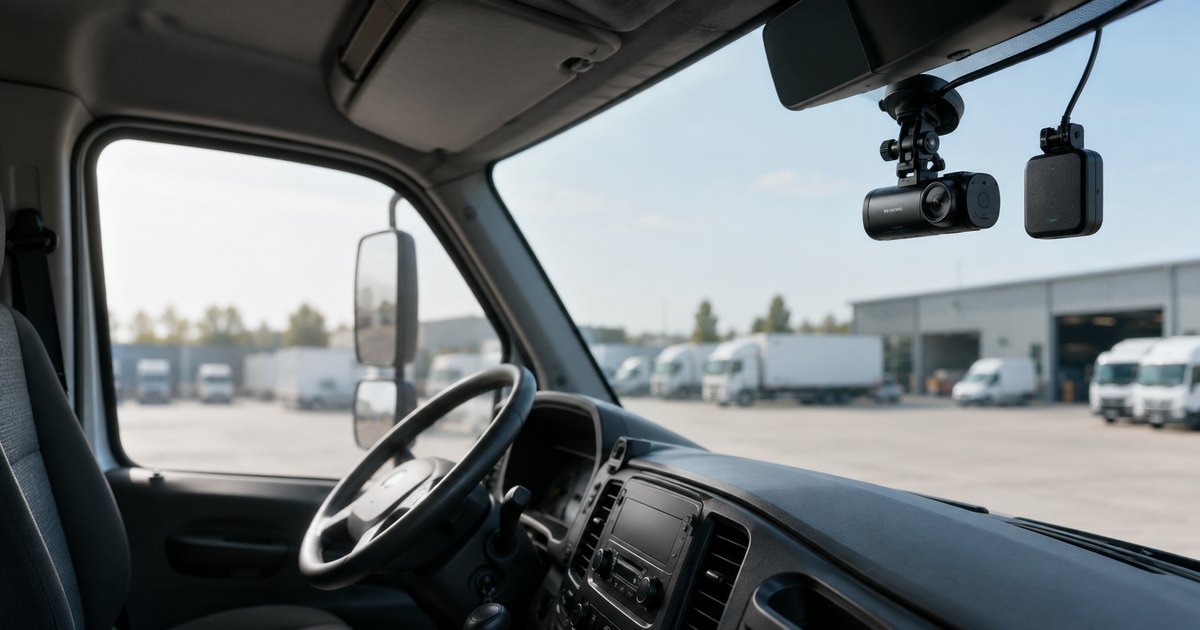
In-cab and road-facing cameras record the moments around a crash or near-miss, providing objective evidence of what happened and a coaching tool for behaviors telematics alone cannot see — following distance, intersection behavior, distraction. Carriers increasingly view camera adoption as a marker of a serious safety culture.
The defensive value is direct: in a disputed accident, dash-camera footage frequently establishes that the company driver was not at fault, which can prevent a meritless claim from becoming a paid loss. Paired with telematics, cameras give a fleet both the data that a problem is developing and the footage to coach it specifically — the kind of closed loop underwriters reward.
Is there a written post-accident protocol?
A post-accident protocol is the step-by-step procedure a driver follows after a crash — securing the scene, documenting it, gathering witness and other-party information, and reporting the claim promptly — written down and trained in advance. Fast, complete reporting materially affects how a claim resolves.
Prompt reporting lets the carrier control the claim from the first day, preserve evidence, and engage early, all of which tend to reduce the ultimate cost. A protocol that includes a post-incident review — what happened, was it preventable, what changes — closes the loop back to the rest of the program and shows an underwriter the fleet learns from every event rather than simply absorbing it.
How does a fleet safety program convert into premium credit?
A fleet safety program converts into premium credit when the proof is packaged and presented to the underwriter at submission — not left to be discovered, and not described in generalities. A carrier cannot credit what it cannot see, and the difference between a fleet that “is safe” and one that earns a documented discount is almost always the quality of the submission.
In practice, that means assembling the written policy with signature pages, the DQ files, telematics enrollment and a sample exception-and-coaching report, the camera deployment summary, the post-accident protocol, and a short narrative of results — fewer at-fault crashes, an improving telematics score, training completed. Iowa fleets carry a real severity exposure to package against: the state sits at the crossing of Interstates 80 and 35, two of the busiest freight corridors in the country, which means local drivers routinely share the road with heavy through-traffic and the cost of a single serious crash runs high. A program presented as organized, current evidence gives an underwriter the basis to apply a credit; the same facts buried in a filing cabinet earn nothing.
How Avanti Group helps prove your fleet safety program
At Avanti Group, a fleet safety program is treated as an underwriting asset to be built and presented, not paperwork to be produced after a loss. Before recommending any commercial auto coverage, we run a Business Risk Diagnostic™ to map how the fleet is used, who is driving it, and which of the five components are documented, which are informal, and which are missing — then we help close the gaps and assemble the proof into a submission an underwriter can actually credit. That work ties the program back to the broader total cost of risk, because the catastrophic loss a working program prevents is almost always far larger than the premium credit it earns.
A program that lives in writing, is applied consistently, and is presented as evidence is what turns safety into leverage at renewal. The goal of a sound commercial auto insurance program is coverage that holds up when something goes wrong, placed inside a wider commercial insurance program built on clarity, strategy, and discipline — not on the lowest available rate. Most agents will quote your fleet on price; we start by proving how well you run it.
Frequently Asked Questions
What is a fleet safety program?
A fleet safety program is a written, enforced set of practices that govern how a business hires and monitors drivers, maintains vehicles, tracks driving behavior, and responds to crashes. The core components carriers look for are a signed written safety policy, a complete driver qualification file with regular MVR reviews, telematics that records driving behavior, in-cab and road-facing cameras, and a written post-accident protocol. The defining feature is that it is documented and applied consistently to every driver and vehicle, because uniform, recorded practice is what an underwriter can actually verify and reward.
How does a fleet safety program lower commercial auto premiums?
It lowers premiums in two ways. Directly, many carriers offer credits or telematics-based discounts for fleets that install and actively use recognized safety technology and can document a real program. Indirectly and more powerfully, a working program reduces the frequency and severity of crashes, which improves the loss history that drives long-term pricing. The key is presentation: the credit is applied when the proof — signed policies, DQ files, telematics reports, camera deployment, and the post-accident protocol — is packaged and given to the underwriter at submission, not left to be discovered.
What is telematics and do carriers really give a discount for it?
Telematics is GPS and sensor technology that records how vehicles are driven — speed, hard braking, rapid acceleration, cornering, and idle time — and turns that behavior into data. Many carriers do offer a telematics insurance discount or premium credit, but the credit is for using the data, not merely installing the device. A fleet that reviews exception reports, coaches the drivers who trigger them, and can show its scores improving over time presents a measurably better risk than one with devices installed and ignored, and that is what underwriters reward.
Do small fleets need a written safety program, or is that just for large trucking companies?
Small fleets benefit as much as large ones, often more. A serious commercial auto crash can produce a loss that threatens a small business far more than a large one, and underwriters apply credits to small accounts that document a real program. The components scale down cleanly: a signed one-page safety policy, MVR pulls on every driver, an affordable telematics app, dash cameras, and a written post-accident checklist are all within reach of a fleet of a handful of vehicles. The same standard should also cover employees who drive their own vehicles for work.
How do I prove my fleet safety program to an underwriter?
Assemble the documentation and submit it proactively rather than waiting to be asked. That package includes the written safety policy with driver signature pages, the driver qualification files, telematics enrollment plus a sample exception-and-coaching report, a summary of camera deployment, the written post-accident protocol, and a short narrative of measurable results such as fewer at-fault crashes or an improving telematics score. A carrier cannot credit what it cannot see, so the quality and organization of that submission is usually what separates a fleet that earns a documented discount from one that does not.