
“I just use it for work” stops working the moment your vehicle’s business use goes beyond ordinary commuting — when the truck is titled in the business’s name, hauls tools or materials for pay, carries business signage, or is driven by employees. At that point a personal auto policy’s business-use limitations can leave a claim partly or fully unpaid, and a commercial auto policy is no longer optional.
The line between personal and commercial auto is not about how the vehicle looks; it is about who owns it, how it is used, and who is exposed when something goes wrong. Personal auto policies are priced and written for household risks, and they contain language that pulls back coverage when the vehicle starts functioning as a business asset. Many business owners discover this only at claim time, when the denial letter arrives. This article walks through where the line actually sits — business-use exclusions, business-titled vehicles, and the trade trucks that live in both worlds — so you can find out where you stand before a loss does it for you.
What is the difference between personal and commercial auto insurance?
A personal auto policy covers a household’s vehicles for personal use, while a commercial auto policy covers vehicles owned or used by a business, with higher available limits, business-specific coverages, and the business itself as the named insured. The difference is less about the vehicle and more about the legal entity and the exposure behind the wheel.
A personal auto policy assumes the worst day it will ever face is a serious accident involving a household member. A business accident is a different animal: the injured party’s attorney is not just suing a driver, they are suing a company — its assets, its receivables, its future. That is why a commercial auto insurance policy sits inside a broader commercial insurance program, with liability limits sized for a business lawsuit rather than a fender bender. Most agents will quote whichever policy is faster and cheaper. The better question — the one a fast quote never asks — is which policy actually responds when the use is commercial.
When does business use void a personal auto policy?
A business-use exclusion is policy language in a personal auto policy that removes or restricts coverage when the vehicle is used in a business — most strictly for delivery, livery, and transporting goods or people for a fee. Personal policies generally tolerate commuting and incidental business errands; they are not built for a vehicle that earns its keep.
The trouble is the gray zone in between, and it is wider than most owners think. Driving to a client site occasionally is usually fine. Hauling materials to job sites daily, making deliveries, carrying paid passengers, or driving for a delivery platform usually is not — and insurers ask about use at claim time, not just at application time. If the facts of the loss show regular business use that was never disclosed, the carrier may deny the claim, pay it and non-renew, or rescind for misrepresentation. The same gap runs in the other direction, too: when employees drive their own cars on company errands, the business itself is exposed, which is exactly the gap hired and non-owned auto coverage exists to close.
What happens when the vehicle is titled in the business’s name?
A vehicle titled or registered to an LLC or corporation generally cannot be insured on a personal auto policy at all, because the named insured on a personal policy must be a person — and the entity that owns the vehicle would have no coverage. This is the cleanest line in the whole topic: business title means commercial policy, full stop.
Owners hit this one almost by accident. The accountant recommends titling the new truck in the LLC for tax or liability reasons, the truck gets added to the household’s personal policy out of habit, and nobody connects the two decisions. Now the policy’s named insured does not own the vehicle, and the vehicle’s owner — the entity with the assets — is not an insured. At a serious loss, that mismatch is the first thing a claims adjuster checks. A commercial auto policy fixes it structurally: the business is the named insured, and the covered-auto symbols on the declarations define exactly which vehicles — owned, hired, or non-owned — the policy protects.
What about trade vehicles — the pickup that does both jobs?
Iowa runs on exactly this vehicle: the contractor’s pickup that pours concrete on weekdays and pulls a camper on weekends, the farm truck that is also the family truck. In a state whose economy leans on construction trades and agriculture, the double-duty pickup is the rule, not the exception — and it is where the personal/commercial line gets tested most often.
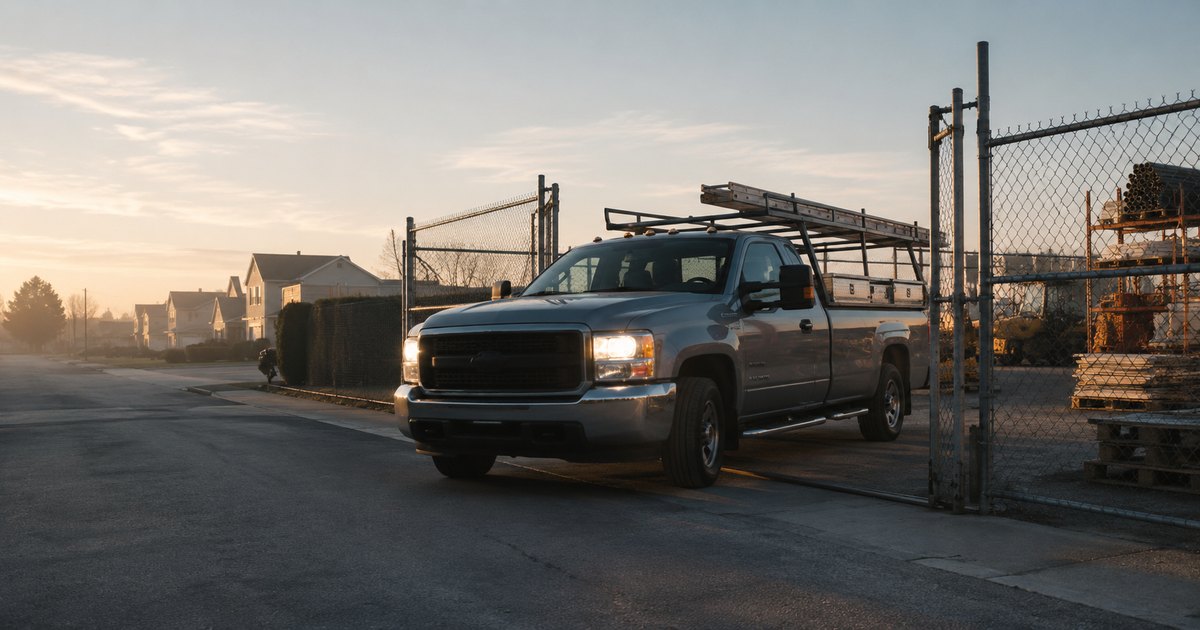
Three signals push a trade vehicle toward commercial: permanent business equipment (ladder racks, toolboxes, mounted compressors), business signage or wraps, and gross weight — heavier work trucks are often outside personal policy eligibility entirely. There is also a limits problem that no sticker price reveals. Iowa’s minimum liability limits are $20,000 per person, $40,000 per accident, and $15,000 in property damage; even a well-built personal policy rarely exceeds $500,000. A jury deciding a serious injury case against a business does not think in those numbers. Insuring a working truck on a personal policy because the premium is lower is the textbook case of the cheap quote that becomes the most expensive policy you ever own — the savings are real until the claim is.
How does Avanti Group decide which policy a vehicle belongs on?
At Avanti Group, this question never gets answered from a quote screen. Before recommending where a vehicle belongs, we run a Business Risk Diagnostic™ — mapping who holds title, how each vehicle is actually used through the year, who drives it, and what would be exposed in a worst-case claim. Often the answer is a commercial auto insurance policy for the working trucks alongside a properly structured personal program for the household vehicles, with no gap and no double-paying between them.
That sequence — assessment first, then structure, then price — is the opposite of how auto coverage is usually sold, and it is the difference between a policy that looks fine and a commercial insurance program that holds up when something goes wrong. If your truck has started earning its keep, find out which side of the line it is on before a claim decides for you.
Frequently Asked Questions
Can I use my personal vehicle for business?
For ordinary commuting and occasional business errands, usually yes. But regular business use — hauling tools or materials to job sites, making deliveries, transporting people or goods for a fee, or letting employees drive the vehicle for work — moves beyond what a personal auto policy is written to cover. Tell your agent exactly how the vehicle is used; undisclosed business use is one of the most common reasons auto claims are denied or policies rescinded.
When do I need commercial auto insurance?
You need a commercial auto policy when the vehicle is titled or registered to a business, used regularly for business purposes (deliveries, job-site hauling, client transport), fitted with permanent business equipment or signage, heavy enough to fall outside personal policy eligibility, or driven by employees. Any one of these is enough — and if several apply, a personal policy is the wrong contract regardless of price.
What happens if I have an accident while using my personal car for work?
It depends on the use and the policy language. Incidental business use is often covered, but losses tied to delivery, livery, or regular undisclosed business use can be denied under the policy’s business-use limitations. Even when the personal policy pays, its limits are sized for household risk — if the claimant sues your business as well, the personal policy does not defend the company. That gap is why businesses carry commercial auto and hired and non-owned auto coverage.
My truck is titled in my LLC. Can it stay on my personal auto policy?
No — and this is the clearest line in the whole topic. A personal auto policy’s named insured must be a person, so an LLC-titled vehicle leaves the actual owner of the vehicle uninsured. The mismatch between who owns the truck and who the policy covers is among the first things an adjuster verifies after a serious loss. A business-titled vehicle belongs on a commercial auto policy with the LLC as the named insured.
Is commercial auto insurance more expensive than personal auto?
Usually, yes — commercial policies carry higher limits, broader business coverages, and rate for the heavier exposure a business creates. But the comparison is misleading, because the two policies are not substitutes: a personal policy priced for household risk simply does not respond to a business loss the same way. The cost that matters is not the premium difference; it is the uncovered claim, the denied loss, or the lawsuit a personal policy was never built to defend.
Related reading
Other articles in the Commercial Foundations series:
- Comprehensive vs Collision on Commercial Auto: What’s Worth Carrying — Comprehensive and collision are the optional physical-damage halves of a commercial auto policy — comprehensive for weather, theft, and fire, collision for impact — and whether each vehicle should carry them turns on the unit’s value, lender or lease requirements, and deductible math, not on habit; the aging, fully owned truck is where most physical damage premium is quietly wasted.
- Commercial Auto Symbols 1, 7, 8, 9 Explained: Why the Number Decides What’s Covered — The covered-auto symbol beside each coverage decides which vehicles it insures — Symbol 1 covers any auto, Symbol 7 only the scheduled ones, and 8 and 9 add hired and non-owned — so a bare Symbol 7 on liability quietly leaves rented trucks and employees’ cars uncovered.
- Hired and Non-Owned Auto: The Coverage Most Small Businesses Are Missing — Hired and non-owned auto (HNOA) covers a business’s liability when employees drive personal cars or rented vehicles for work — the auto exposure a general liability policy excludes and most owners never price, answered by an inexpensive endorsement that sits over the employee’s personal policy.
- Why Commercial Auto Rates Are Climbing and What to Do About It — Commercial auto rates keep rising on forces outside any one business’s control — nuclear verdicts, third-party litigation funding, social inflation, and distracted-driving severity — so even a claim-free fleet sees its renewal climb, and the fix is structuring coverage and managing total cost of risk, not chasing the cheapest quote.