
On a syndicated or private equity owned property, a claim that comes back short doesn’t just cost the owner. Somebody still has to fund the rebuild, cover the mortgage while rents are down and pay the deductible, and on a deal with outside investors that often means a capital call. The seven gaps below are where that usually starts: deductibles, loss of rents, valuation, code upgrades, the cause of loss form, vacancy during renovations and an umbrella that never grew with the portfolio.
Avanti Group works with real estate owners and sponsors on commercial property and apartment and habitational programs. This article is written for general partners, syndicators and fund managers who answer to investors when a loss hits. For the broader case for why these items matter, start with why we push so hard on commercial property coverage.
- Why is an insurance gap riskier on a syndicated deal?
- Gap 1: Percentage wind and hail deductibles
- Gap 2: Loss of rents that runs out before the rebuild does
- Gap 3: A building limit that isn’t today’s rebuild cost
- Gap 4: No ordinance or law coverage on an older building
- Gap 5: A named-perils cause of loss form
- Gap 6: Vacancy during a value-add renovation
- Gap 7: An umbrella that didn’t grow with the investment
- Does this apply to private equity owned businesses too?
- Will the liability policy respond at all?
- Who is watching the property manager?
- Grills, and the other rules carriers expect you to enforce
- Flood, and how the property limit is structured
- What else should sponsors check?
- Is a higher deductible ever the right call?
- How to review a property program before investors are exposed
- Frequently asked questions
Why is an insurance gap riskier on a syndicated deal?
Because the money at risk belongs to investors, and the plan to fund a shortfall is usually a capital call, a missed distribution or a hit to the sponsor’s own balance sheet.
As Rich Bales puts it: “Too many operators miss these. It matters most for private equity groups and syndicators, because other people’s money is on the line, and a gap that saves premium today can become a capital call tomorrow.”
Most syndication budgets are built on a tight reserve and a projected distribution schedule. An uninsured $400,000 is not a rounding error in that model. It is a phone call to every investor in the deal.
Gap 1: Percentage wind and hail deductibles
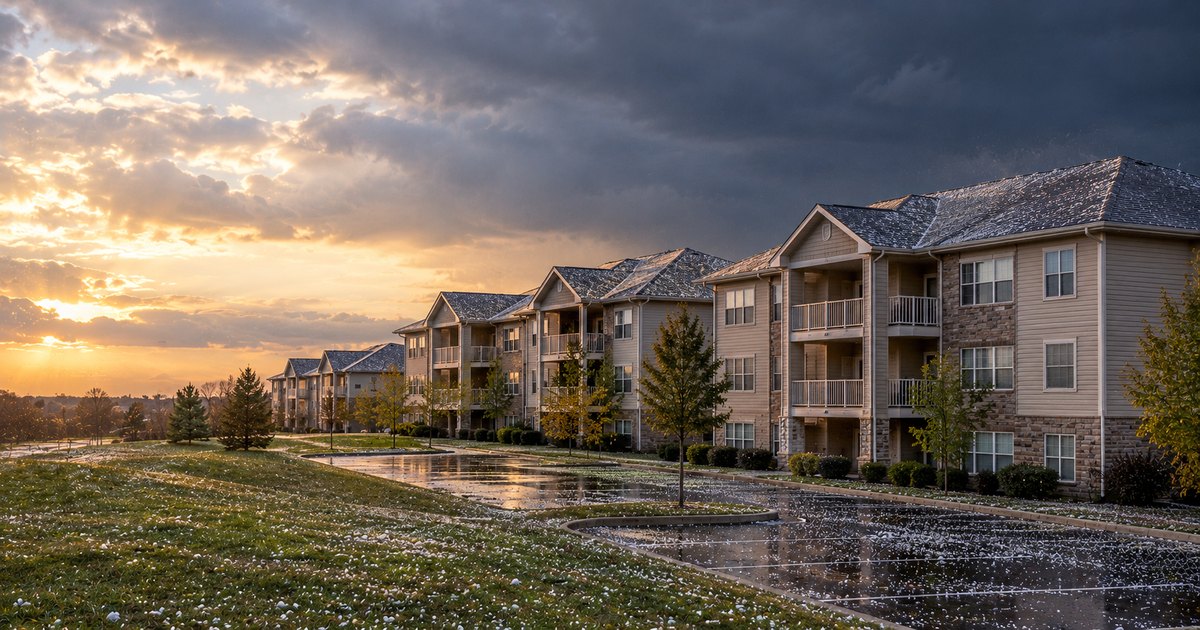
A percentage wind and hail deductible applies to each building’s value, so one storm across a multi-building property can produce a six-figure out-of-pocket loss.
A 2% deductible on a building insured for $3.4 million is about $69,000. On a six-building community, one hailstorm that hits every roof means roughly $413,000 before the policy pays anything. In the Midwest, that is a far more likely event than a total loss from fire.
Higher deductibles can be a perfectly reasonable way to lower premium. The question is whether the reserve was sized for them and whether investors were told.
Gap 2: Loss of rents that runs out before the rebuild does
Loss of rents coverage replaces income while a damaged building is being repaired, and if the limit or the time period is too short, debt service comes from somewhere else.
When rent stops, distributions stop, but the mortgage doesn’t. Many policies cover 12 months of lost rent. On an older building, a major rebuild can run longer once permits, code upgrades and contractor availability are factored in. An extended period of indemnity covers the lease-up after repairs finish, when units are rebuilt but not yet re-rented. Check that the limit reflects actual rents, and see our guide to business income and extra expense for how the coverage is measured.
Gap 3: A building limit that isn’t today’s rebuild cost
If the building limit is below what the property costs to rebuild today, a coinsurance penalty can cut every claim, and a total loss leaves a shortfall the investors fund.
Purchase price, assessed value and loan amount are not replacement cost. In one real case, a condominium building worth about $2.47 million carried $247,100 of coverage, and an 86% penalty left the association with about $5,500 on roughly $46,000 of damage. More examples are in coinsurance penalty court cases. A detailed replacement cost estimate and an agreed value endorsement close this gap.
Gap 4: No ordinance or law coverage on an older building
Ordinance or law coverage pays for the code upgrades, demolition and undamaged portions a rebuild triggers, and older value-add properties carry the largest exposure.
The buildings syndicators like to buy, older assets with upside, are the ones furthest from current code. In one case, a fire in two condo units led the city to require the same ductwork to be replaced across all 18 buildings. See ordinance or law claim examples for what happened when the coverage was and wasn’t in place.
Gap 5: A named-perils cause of loss form
A broad form policy covers only a list of named perils, so losses like theft fall outside it entirely.
Stolen appliances from units between tenants, stripped copper and stolen HVAC condensers are common at apartment properties, and none of them are on the broad form list. In one case, thieves did about $200,000 of damage to steal about $2,000 of copper, and the owner collected nothing. Read broad form vs special form before assuming your form is special.
Gap 6: Vacancy during a value-add renovation
On a standard commercial property form, a building is considered vacant unless at least 31% of it is rented and in use, and after 60 consecutive days of vacancy, some coverage drops away and the rest is reduced.
On the standard form, a vacant building loses coverage for vandalism, sprinkler leakage, glass breakage, water damage and theft, and other covered losses are reduced by 15%. A heavy renovation that empties a building can trip that clause. Major projects may also need builders risk coverage for the work itself. Tell the carrier the renovation plan before it starts.
Gap 7: An umbrella that didn’t grow with the investment
Umbrella and excess liability limits are often set once and never scaled as the portfolio grows, which leaves a large verdict to be paid from the equity investors put in.
A serious injury claim at an apartment property, from a fire, a fall or a security incident, can outgrow the primary general liability limit. Whatever the umbrella doesn’t pay comes out of the ownership entity, which means the property’s equity. A portfolio that has doubled in units or value since the umbrella was bought is carrying the same liability protection on twice the exposure.
No one buys a $100 million umbrella for an apartment community, and that isn’t the point. The verdicts that matter most for sizing an umbrella are the ones in the $5 million to $15 million range, where a well-sized program pays and a thin one doesn’t:
- $12 million: a staircase that gave way. A tenant at Legacy Corner Apartments was hurt when a deteriorated staircase collapsed under him, and later developed a chronic pain condition. The owner and manager rejected a $1.25 million offer before trial. The jury returned $12 million, half of it punitive damages. Some states don’t allow punitive damages to be insured at all.
- $4.3 million: broken gates and dead cameras. A Harris County, Texas jury returned a $4.3 million verdict in a fatal intrusion at Magnolia Cove Apartments, where the family alleged broken gates, poor lighting, non-working cameras and no patrols.
- $4.5 million: a gate left broken for months. In Plantation, Florida, a jury awarded $4.5 million after two siblings were killed in their apartment. The owner was found 40% at fault, about $1.8 million, and the Florida Supreme Court reinstated the verdict six years later.
The largest verdicts show where the trend is heading. Marathon Strategies counted 190 verdicts of $10 million or more against companies in 2025, totaling more than $25.6 billion, the highest count since 2009. Premises liability verdicts alone reached $602 million across 20 cases, up from $134 million across five in 2024. That includes outliers like a $140 million verdict in Atlanta against an apartment owner after a fatal fire, where the insurer then sued to argue its policy didn’t cover the death at all.
What happens when a verdict exceeds the limits? Most apartment deals sit in a single-property LLC, so the sponsor’s other properties are usually shielded. The property inside that LLC is not. A judgment above the limits can force a settlement out of the property’s cash flow, a sale or a bankruptcy of the entity. Either way, the equity in that property, which is the investors’ money, is what’s at risk.
Limits also shape settlements. Most liability claims settle, and the available limits often anchor the number. A thin program invites a demand at the limits early, and a case that doesn’t settle can come back far higher. In the staircase case, a $1.25 million offer was turned down and the verdict was nearly ten times that. The goal is a limit large enough that a serious claim gets resolved inside the insurance, not out of the equity. And as the Atlanta case shows, the limit only matters if the policy responds, so the exclusions on a habitational liability policy deserve the same attention as the limit.
As Rich Bales puts it: “Too often, the umbrella doesn’t grow with the investment.” See how big your commercial umbrella should be and excess vs umbrella for how limits are set and stacked.
Does this apply to private equity owned businesses too?
Yes. Any program protecting investor capital, whether a real estate syndication or a PE-owned operating company, carries the same tension between return targets and insurance cost.
As Rich Bales puts it: “Return pressure pushes a lot of owners toward the lowest insurance price, and I understand why. But when investors’ capital is on the line, the insurance program is no place to cut corners. It should be one of the tightest parts of the deal.” Saving premium is a good thing. Saving it by leaving gaps that investors would fund is a different decision.
Will the liability policy respond at all?
Apartment liability policies increasingly carry exclusions or reduced sublimits for the claims apartment owners actually face, so the limit on the declarations page can overstate the protection.
- Assault and battery. Exclusions for assault and battery claims are increasingly common on apartment and landlord policies, especially in higher-crime areas, and where the coverage can be added back, it often carries a lower sublimit than the rest of the policy. That matters, because negligent security claims are among the largest verdicts apartment owners face.
- Habitability. Claims that a property wasn’t kept livable, such as mold, pests, leaks, faulty wiring or missing smoke and carbon monoxide detectors, are another target. CRC Group reports carriers adding habitability, vermin, mold and lead exclusions, and that typical awards in California habitability suits rose from $15,000 to $25,000 per plaintiff to $75,000 to $100,000.
- Animals. Some policies exclude dog bites or certain breeds, which can leave an attack in a common area uncovered.
Read the exclusions page as carefully as the limits page. If a policy excludes the claim, the umbrella above it usually won’t pick it up either.
Who is watching the property manager?
A third-party manager collects the rent, holds deposits and runs the site, so the ownership entity needs to know how it’s protected if the manager makes a mistake or someone steals.
- Crime coverage. Employee theft, forged checks and fraudulent wire instructions can hit rent collections and reserves. Confirm whether the ownership entity or the manager carries crime coverage, and whose employees it covers.
- The management agreement. It should require the manager to carry its own general liability, professional liability, employment practices and crime coverage, name the ownership entity as an additional insured where appropriate, and spell out who indemnifies whom.
- Certificates every year. Collect and review the manager’s certificates at every renewal, not just at takeover.
Grills, and the other rules carriers expect you to enforce
Many carriers set rules for grills at apartment properties, from outright bans on balconies and patios to minimum distances from the building, and a property that doesn’t enforce them can create a coverage problem.
Carriers handle grills in different ways: exclusions, requirements that grills stay a set distance from the building, and other conditions. West Bend Insurance, for example, publishes a rule that no grilling, deep frying or heating of any kind can take place on decks, patios, porches or balconies, and that grills must be at least 10 feet from combustible materials such as building walls, with stricter local rules, such as 25 feet, taking precedence. Many local fire codes restrict open-flame cooking on balconies of multifamily buildings as well.
The reason is simple. The National Fire Protection Association reports an average of about 7,900 home fires a year caused by gas grills, peaking in July, according to West Bend. On a wood-framed walk-up, a grill fire on one balcony can spread to every unit above it.
What to do:
- Know your carrier’s rule before closing, and whether it is an exclusion, a distance requirement or a condition of coverage.
- Put it in the lease. A written clause prohibiting grills on balconies, patios and decks, and storage of grills there, gives the manager something to enforce.
- Enforce it and document it. Posted rules, inspections and notices show the carrier, and a court, that the rule is real.
- Offer a better option. A designated grilling area away from the buildings makes the rule easier to follow.
The same approach applies to the other operating rules carriers commonly set for apartment properties, such as smoke and carbon monoxide detectors in every unit and the condition of stairs, railings and balconies. If the carrier made it a requirement, the lease and the manager’s routine should reflect it.
Flood, and how the property limit is structured
Standard property forms exclude flood, lenders often require it, and the way a portfolio’s limits are structured can cap what a single building recovers.
- Flood. Federally regulated lenders must require flood insurance on loans secured by buildings in a mapped special flood hazard area. The National Flood Insurance Program tops out at $500,000 of building coverage for other residential and nonresidential buildings, which is often well short of an apartment building’s value, so excess flood coverage may be needed above it.
- Blanket limits and margin clauses. Portfolios are often insured on a blanket limit across several properties. Some blanket policies carry a margin clause that caps recovery at any one location to a percentage of the value reported for it, such as 110%. If a building was under-reported on the statement of values, the margin clause limits the claim even when the blanket limit has room. Accurate values on every building are what make the blanket work.
What else should sponsors check?
Two parties beyond the investors care about the insurance: the lender and, after a loss, anyone second-guessing the general partner’s decisions.
- Lender requirements. Loan documents commonly set minimums for building limits, deductibles, ordinance or law and loss of rents. Falling short can create a default or lead the lender to place coverage at the borrower’s cost. Claim payments are typically made jointly with the lender, and some loan documents allow proceeds to be applied to the loan rather than the rebuild.
- The general partner’s own exposure. Offering documents often describe the insurance program. If a loss reveals the property was underinsured to improve returns, investors may question that decision. Management liability coverage for the sponsor entity is worth reviewing at the same time as the property program.
Is a higher deductible ever the right call?
Yes, when it is a deliberate decision with a funded reserve behind it and investors understand it.
Insurance is a question of how much risk you keep and how much you transfer. Some sponsors choose higher deductibles and hold cash for them, and that can be sound. The problem is when the trade was made only to hit a premium number, the reserve was never sized for it, and investors learn about it after the loss.
As a portfolio grows, there are more structured ways to keep risk on purpose, from portfolio programs to captives. See insurance programs and captives for apartment owners.
How to review a property program before investors are exposed
- Build a replacement cost estimate for every building, priced on today’s costs, and request agreed value.
- Model the deductibles against a realistic storm that hits every building, and size the reserve to match.
- Check loss of rents against actual rents, with a period long enough for a real rebuild plus lease-up.
- Confirm ordinance or law limits on every older building.
- Scale the umbrella to the current size of the portfolio, not the size it was when the policy was first bought.
- Confirm special form on every building on the schedule.
- Share the renovation and vacancy plan with the carrier before work starts.
- Read the liability exclusions, especially assault and battery, habitability and animals.
- Review the property manager’s insurance and the management agreement, and confirm crime coverage.
- Check flood zones and the margin clause, and confirm every building’s reported value.
- Match the lease to the carrier’s rules on grills and other operating requirements, and enforce them.
- Compare the program to the loan documents and the offering documents.
The Business Risk Diagnostic™ is how Avanti Group reviews an existing property program before acquisition, at refinance or ahead of renewal, so the sponsor knows what is being kept and what is being transferred.
Frequently asked questions
Who pays when a syndicated property’s insurance claim falls short?
The ownership entity, which in practice means reserves, missed distributions, the sponsor or a capital call to investors. The policy only pays what it covers, after the deductible.
How much loss of rents coverage does an apartment syndication need?
Enough to cover actual rents for the realistic length of a major rebuild, plus time to re-lease units afterward. That is often longer than 12 months on an older building, which is where an extended period of indemnity helps.
How does a percentage wind and hail deductible work on multiple buildings?
It is usually calculated as a percentage of each damaged building’s insured value. A storm that damages several buildings can produce a separate deductible amount for each one, so the total can be large.
Can a renovation affect property coverage?
Yes. On a standard commercial form, a building less than 31% rented and in use is considered vacant, and after 60 days some coverage is removed and other losses are reduced. Major work may also need builders risk.
How much umbrella coverage should a real estate syndication carry?
Enough to protect the equity in the portfolio as it stands today. Review the limit whenever units, properties or values grow, rather than leaving it at the amount bought for the first deal.
Do apartment liability policies cover assault and habitability claims?
Not always. Assault and battery exclusions and reduced sublimits are increasingly common, and some carriers add habitability, mold, vermin and animal exclusions. Read the exclusions, not just the limits.
Can grills on balconies affect an apartment insurance policy?
Yes. Many carriers prohibit grills on balconies and patios or require them to be a set distance from the building, often 10 feet or more. Put the rule in the lease and enforce it.
Do lenders have insurance requirements for apartment loans?
Commonly, yes. Loan documents often set minimums for building limits, deductibles, ordinance or law and loss of rents. Compare the policy to the loan documents before closing and at every renewal.
Sources
- Legacy Corner Apartments verdict: https://www.nstlaw.com/blog/verdict-12-million-awarded-negligence-lawsuit-apartment-complex/
- Magnolia Cove Apartments verdict (Harris County, Tex.): https://doylelawfirm.com/doyle-dennis-avery-llp-secures-4-3-million-verdict-in-fatal-apartment-complex-security-case-texas-negligent-security-lawyers/
- Gatehouse on the Green verdict (Plantation, Fla.): https://thenationaltriallawyers.org/article/premises-liability-verdict/
- Venetian Hills verdict, Atlanta Journal-Constitution: https://www.ajc.com/news/atlanta-news/jury-awards-140m-over-apartment-fire-at-troubled-atlanta-complex/72JTQEG5X5EVHNWGJQKDQAE2OY/
- CRC Group, Habitability Lawsuits Raise New Risks for Apartment Owners and Insurers: https://crcgroup.com/Tools-Intel/post/habitability-lawsuits-raise-new-risks-for-apartment-owners-insurers
- Mahoney Group, Landlords’ Latest Threat: Assault and Battery Coverage Exclusions: https://www.mahoneygroup.com/landlords-assault-and-battery-coverage-exclusions/
- Congressional Research Service, A Brief Introduction to the National Flood Insurance Program (2025): https://www.everycrsreport.com/files/2025-04-22_IF10988_1d0a7984da08a24c3c75ad26f67683794cc395f8.html
- West Bend Insurance, Preventing Grilling Fires in Apartment Buildings (August 2025): https://www.thesilverlining.com/west-bend-blog/preventing-grilling-fires-in-apartment-buildings
- IRMI, Margin Clause: https://www.irmi.com/term/insurance-definitions/margin-clause
- Marathon Strategies nuclear verdicts findings, via Risk & Insurance: https://riskandinsurance.com/nuclear-verdicts-against-companies-hit-record-high-in-2025-topping-25-6-billion/
- King v. Casa Grande Condominium Ass’n (5th Cir. 2011): https://www.ca5.uscourts.gov/Opinions/unpub/10/10-30237.0.wpd.pdf
This article is for general education and is not legal or investment advice. Coverage depends on the wording of each policy, and lender and offering requirements vary by deal.